The Girl Melbourne Gave Back
A couple of weeks ago, if you’d asked me what I was most worried about, I probably would have said getting on a plane by myself and leaving my husband and kids to travel interstate, during school holidays, while he still had to try to work.
I hadn’t travelled by myself for nine years. Somewhere between having children, supporting a family living with haemophilia, navigating my own health challenges, surgery, work and everything else life throws at us, travelling alone had quietly become something that felt completely outside my comfort zone. The irony wasn’t lost on me either. I’d spent more than 5 years working as cabin crew, happily flying around Australia and regularly travelled interstate and overseas on my own from when I was 16, yet suddenly the thought of boarding a plane by myself felt enormous.
When Haemophilia Foundation Australia invited me to attend their Women’s Workshop in Melbourne, I was incredibly excited, but equally terrified.
At the time, I thought I was simply flying to Melbourne for a workshop…Looking back now, I realise the workshop was only part of the reason I needed to be there.
Melbourne has always held a special place in my heart. When I was sixteen, I packed my bags, moved away from home and began studying ballet full-time. Those three years shaped so much of who I became. They were physically demanding, emotionally exhausting and some of the hardest years of my life, but they were also filled with hope, determination and a sense that you could achieve anything that you set your mind to.
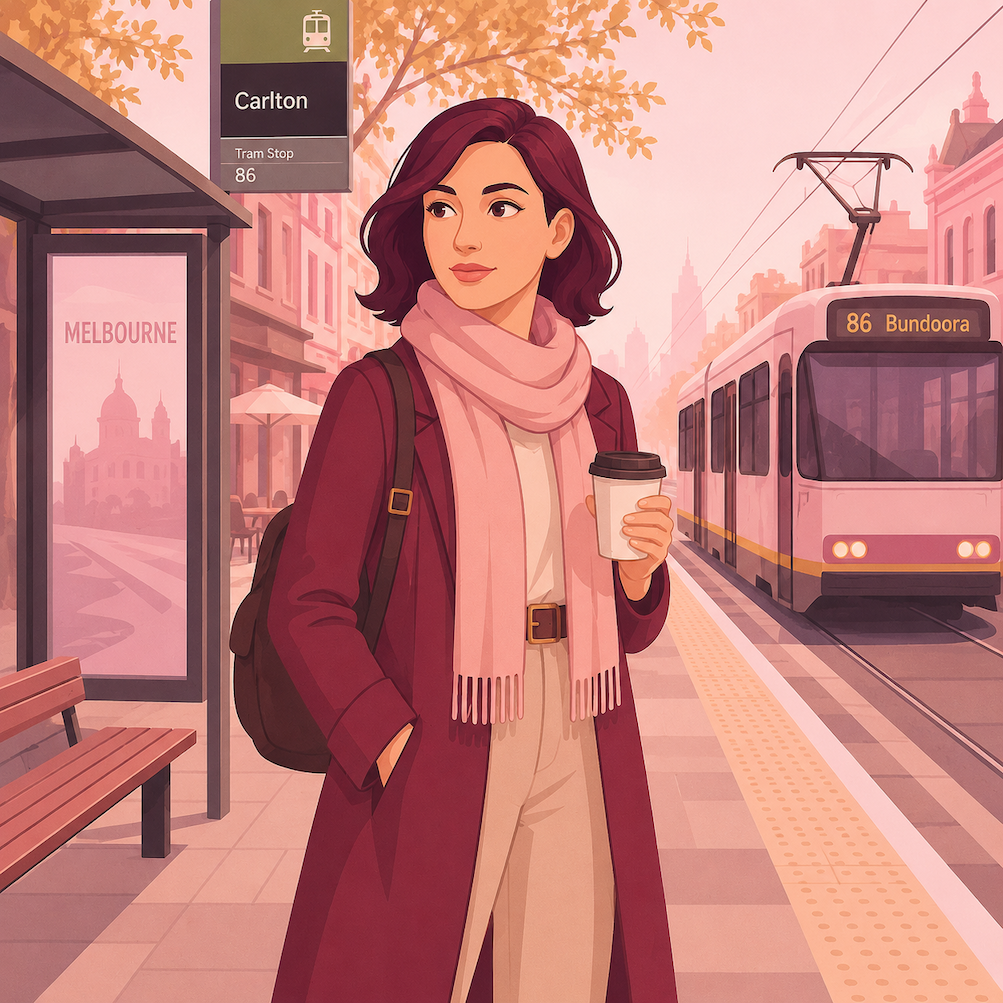
I absolutely loved living in Melbourne. I knew the tram routes, had favourite cafés where I’d escape between classes, and little corners of the city that somehow felt like they belonged to me. I can still picture myself wandering through the South Melbourne Market with whatever cash I had left after paying rent. I’d spend ages in the fruit and vegetable section convincing myself I was making very grown-up decisions about what to cook that week. The reality was I was still a kid, trying to survive on coffee, determination and whatever healthy food I could afford, while also trying to stay ‘ballet’ thin.
I wish I could tell that girl she didn’t need to have everything figured out. But I also admire her. She was incredibly independent, quietly resilient and genuinely believed that hard work could overcome almost anything.
I don’t think I realised until this trip that I’d spent years missing Melbourne, when what I’d also been missing was the person I was while I lived there.
Looking back now, I wonder where that confidence came from. At sixteen, I thought nothing of moving interstate on my own. At eighteen, I moved overseas with little more than a suitcase and a dream, and within two weeks I’d secured a contract with a professional ballet company.
Life felt like one big adventure. The dream definitely didn’t come easy. There were plenty of setbacks and unfortunate road blocks, but I didn’t let anything stop me from dancing…until one day the dream was over and there wasn’t any way to come back from it. It was almost Christmas and during what I now know as my final season of the Nutcracker, a spectacularly dramatic snap rippled through my foot. It was my muscle rupturing. Something I had to try to ignore while I finished the variation, with one flapping foot, and could run off stage…the show must always go on.
It wasn’t until years later that I began looking back at the injury that ended my career differently.
For a long time, I simply believed I’d suffered a ruptured muscle. Now, with everything I understand about bleeding disorders, I strongly suspect it began with a bleed around my sesamoid bones. My foot became swollen, hot and incredibly painful. I remember reaching the point where I couldn’t even fit it into my pointe shoe. I asked whether it could be related to my haemophilia, but the answer was always the same.
“You don’t have haemophilia.” “It can’t be a bleed. You’re a female.” “Females are just carriers, it’s lucky you aren’t a male.”
So it was treated as a sports injury instead. I received cortisone injections to reduce the inflammation, but the injections ultimately weakened the surrounding tissue. Eventually the muscle ruptured, hanging on by little more than a thread. Surgery followed, then years of rehabilitation, and with that, the end of my professional ballet career.
I’ve often wondered how different things might have been if someone had recognised the possibility that my bleeding disorder was playing a role. It’s not a question I’ll ever know the answer to, but I also acknowledge that I wouldn’t be where I am today without that career ending injury and the years of change that followed it.
The hardest part is knowing that there would have been effective treatment for me…if anyone had believed I was bleeding in the first place. That treatment could have prevented the years of pain and rehab that I had to go through while also mourning the loss of my dream and the career I’d made so many sacrifices for.
For many years, I thought that story belonged firmly in my past. Then I walked into a room full of women whose stories sounded remarkably like my own.
The morning before the workshop started, I wandered around the city. I instantly snapped back in time to that teenager with so much hope, spirit and her whole life ahead of her.
I’d forgotten the way Melbourne smells after rain. The tram bells. The coffee drifting out of little cafés before most people had even started work. I caught myself smiling as I recognised streets I’d walked hundreds of times as a teenager, remembering shortcuts I’d long forgotten and wondering whether my favourite little cafés were still tucked away somewhere.
It’s funny how a city can hold memories you didn’t even realise were still there. As I walked, I wasn’t just remembering Melbourne. I was remembering me. The girl who believed she could figure things out. The girl who wasn’t afraid of hard work. The girl who took chances because staying still seemed far scarier than trying.
I didn’t realise how much I’d missed her.
When I walked into the workshop on that first morning, I knew I was there to learn. What I didn’t expect was how much I would learn from the women sitting around me. By morning tea on the first day we’d somehow managed to laugh about the absurd things only women with bleeding disorders understand. Things you’d never dream of discussing with strangers suddenly became normal conversation. There was something strangely comforting about that.
As each person shared their story, I realised we weren’t simply talking about bleeding disorders. We were talking about years of quietly adapting our lives around symptoms we’d been told were “normal”.
One woman spoke about haemorrhaging after childbirth. Another described planning every outing around her menstrual cycle because she never knew when she’d bleed through her clothes or faint from severe anaemia. Someone else talked about years of unexplained swelling, bruising and joint pain before finally receiving a diagnosis.
The details were eerily similar and you could just feel the common solidarity that was forming between us. For the first time in a very long time, I wasn’t trying to convince anyone that my experiences were real. Nobody questioned why heavy periods mattered. Nobody dismissed painful joints. Nobody looked surprised that women could have severe bleeding symptoms.
Everybody simply understood.
I don’t think I realised how exhausting it had become to constantly explain myself until I no longer had to.
One of the biggest eye-openers for me was learning just how little research there is on women with bleeding disorders. We spoke about how many medical studies still don’t include women, not just in bleeding disorders but across medicine more broadly, often because women are considered “too complicated” to study.
When you stop and think about that, it’s extraordinary. For decades we’ve tried to fit women’s experiences into evidence that often wasn’t created with women in mind. No wonder so many of us have spent years feeling unheard. But what struck me most was, despite the lack of support or acknowledgement of their bleeding symptoms, these amazing women showed so much strength and resilience. I found myself looking around the room thinking how many years of courage were sitting there. Women who had spent decades advocating for themselves, their daughters, their sons and one another.
Then another realisation quietly crept in. I hardly ever talk about my own bleeding disorder. Not because it hasn’t affected me, but because for so many years all of my energy has gone into advocating for my son, Lachie. When your child has haemophilia, your own health naturally slips down the list. Every appointment becomes about them. Every injury. Every conversation with specialists. Every phone call. You become very good at fighting for someone else.
What you don’t realise is that somewhere along the way you’ve stopped fighting for yourself.
Listening to the other women, I realised how common that was. So many of us had spent years putting ourselves second. It wasn’t intentional, it’s just what mothers do.
Lachie has lived with complicated bleeding symptoms his entire life. For years he was classified as having mild haemophilia, yet our lived experience didn’t feel mild at all. Even after multiple life threatening gastro-intestinal bleeds when he was only 15 months old, we still questioned ourselves constantly. Were we overreacting? Should we push harder? Was this really another bleed?
Eventually, after 9 years of struggling, he was reclassified as having moderate haemophilia. No parent wants to hear their child’s condition is more severe than first thought, but there was also an overwhelming sense of relief. We hadn’t imagined it. Our instincts weren’t wrong. Years of advocating had finally led to answers. Now that he is classified as moderate, he has also been approved to receive regular treatment, which has absolutely changed all of our lives. It doesn’t stop all of the hospital visits, but the slight reduction and the increased confidence I can see in Lachie has made a real difference.
That experience with Lachie changed me in ways I probably didn’t appreciate until this workshop.
It taught me to trust lived experience. We know our son better than anyone and can tell when things aren’t normal. It taught me that asking questions isn’t being difficult. Sometimes it’s exactly what’s needed. It also taught me that sharing my story is powerful and can instigate change. It was an article that I wrote for Haemophilia Foundation Queensland that ultimately got the ball rolling on Lachie’s re-classification.
One of the greatest unexpected gifts the workshop gave me was connection.
I was so excited that Dawn Rotellini from the National Bleeding Disorders Foundation was one of the main presenters. I spotted Dawn across the room and immediately wondered if she’d remember me. Charlie and I had met her years earlier in New York while filming a documentary about bleeding disorders and Lachie’s journey called Bleeding Love. Within minutes we were talking as though no time had passed at all.
When we first met Dawn, it was right at the start of our mission to find more information about how to navigate bleeding disorders after Lachie had been suffering from so many severe internal bleeds. Even back then, her bright and bubbly personality and her caring and thoughtful advice really stuck with me. It’s one of my core memories from the trip and has stayed with me all these years after. Some people leave an impression on you that never really fades. Dawn was one of those people. The way she connected with all of us at the workshop and allowed us to tell our stories and feel empowered to advocate for ourselves and others really made me realise how much we all have in common.
Those conversations stayed with me. Dawn reminded me that stories matter. That sharing our lived experience isn’t self-indulgent. It’s how change begins.
Over those two days I made friendships that I know will continue long after the workshop ended. We laughed, we cried, we validated one another’s experiences and, perhaps most importantly, we reminded each other that none of us were alone.
By the time I boarded the plane home, I realised I hadn’t spent the last two days constantly worrying about whether everyone else was okay back in Brisbane. That probably sounds like a strange thing to notice. Any parent will understand. Usually my brain is full of lunchboxes, forgotten hats, whether there’s enough milk in the fridge and who needs to do their homework. For forty-eight hours nobody asked me where their shoes were, whether I’d packed snacks or if I’d seen their favourite teddy. It was oddly quiet. I wasn’t quite sure what to do with myself. That alone felt almost revolutionary. For the first time in a long time, I’d had space. Space to think. Space to listen. Space to imagine what might come next.
As I looked out the window somewhere between Melbourne and Brisbane, I realised I’d spent years trying to make sure everyone else felt heard. My son, my family and the people around me. I hadn’t realised I’d quietly stopped listening to myself. It’s something that just happens naturally when you are navigating life, motherhood, medical conditions, trauma and advocating for others when they need it most. You become so focused and spend so much time making sure everyone else is okay, that you stop asking yourself the same question. The workshop made me realise that women shouldn’t have to spend decades convincing people that they know their own bodies. Mothers shouldn’t have to ignore their own health while advocating for everyone else. This really stuck with me and has made me even more determined to support women through these times and find ways to make it feel easier.
That’s what Melbourne gave back to me. The memory of the sixteen-year-old me who believed that taking a leap into the unknown was always better than wondering what if?
She’s older now. A little wiser. A lot more tired. She carries more scars than she did back then. But she’s still optimistic. She’s still determined. And she still believes stories can change things for the better.
I thought I was flying to Melbourne for a women’s workshop. Instead, I came home with new friendships, pages of notes, a renewed determination to finish Bleeding Love, and a head full of ideas I can’t wait to chase. Most unexpectedly of all, I came home with the same quiet optimism I remember carrying around Melbourne when I was sixteen.
It turns out she was never really gone. She’d just been waiting for me to come back.
Read more:
Who Evan Am I Anymore?
The Mental Load is Real
When Mum Gets Sick
Do you ever wonder where the 16 year old you is now? Join the conversation and share the love below!